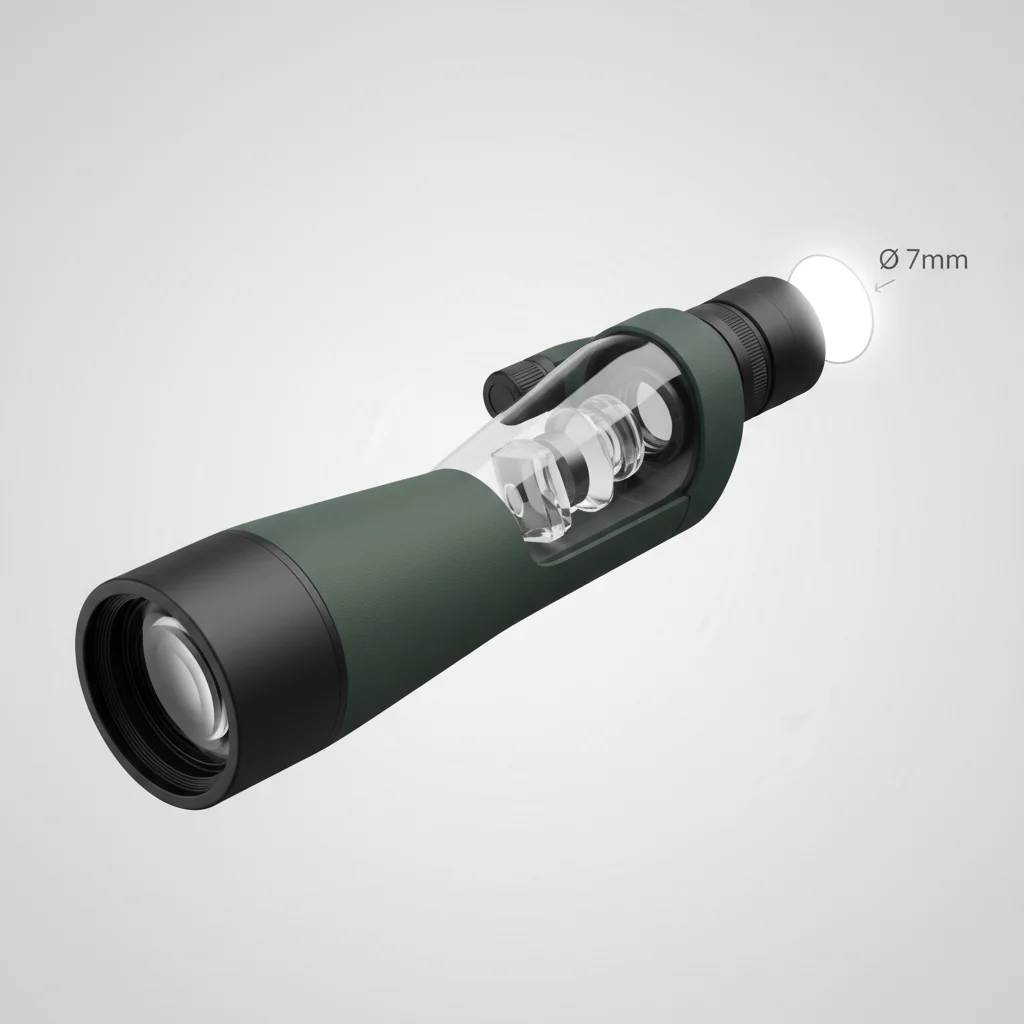
For most users, a spotting scope exit pupil between 3mm and 5mm offers a versatile balance, providing sufficient brightness for daytime viewing and remaining effective in lower light conditions. The ideal size depends on individual viewing conditions and personal vision, but this range avoids being excessively large or small, ensuring optimal image brightness and clarity for various outdoor activities.
What is Exit Pupil and Why Does It Matter?
The exit pupil is the diameter of the light beam that exits the eyepiece of an optical instrument and enters your eye. It’s calculated by dividing the objective lens diameter by the magnification. For example, a 60mm objective lens at 20x magnification yields a 3mm exit pupil (60/20=3). A larger exit pupil generally means a brighter image, especially in dim light, because more light is entering your eye. However, the human eye’s pupil also dilates and constricts, typically ranging from 2-3mm in bright light to 5-7mm in darkness for adults, and less for older individuals. For spotting scopes buying guides on this site.
Matching the spotting scope’s exit pupil to your eye’s pupil size is key for optimal viewing. If the exit pupil is larger than your eye’s pupil, some light is wasted. If it’s smaller, the image will appear dimmer, regardless of how much light your eye could potentially gather. This is particularly important for activities like birding at dawn or dusk, or hunting in shaded areas.
Exit Pupil for Different Lighting Conditions
For bright, sunny conditions, an exit pupil of 2-3mm is often sufficient. Your eye’s pupil will be constricted, and a larger exit pupil won’t offer significant additional benefit in terms of brightness. However, as light levels drop, such as during twilight or on overcast days, a larger exit pupil becomes more advantageous. An exit pupil of 4-5mm can provide a noticeably brighter image, making it easier to discern details in challenging light.
For extreme low-light scenarios, like stargazing or observing nocturnal animals, some users might prefer an exit pupil closer to 6-7mm, assuming their eyes can dilate to that extent. It’s important to remember that the maximum dilation of the human pupil decreases with age, so a younger observer might benefit more from a larger exit pupil than an older one.
Impact on Image Clarity and Eye Strain
While a larger exit pupil contributes to brightness, it can also make the viewing experience more comfortable by providing a larger
Frequently Asked Questions
What is the ideal exit pupil size for a spotting scope?
The ideal exit pupil size for a spotting scope generally ranges between 3mm and 5mm for most users. This range provides a good balance of brightness for both bright daylight and lower light conditions, ensuring versatility across various outdoor activities.
How is the exit pupil of a spotting scope calculated?
The exit pupil of a spotting scope is calculated by dividing the objective lens diameter by the magnification. For example, a scope with a 60mm objective lens and 20x magnification will have a 3mm exit pupil (60mm / 20x = 3mm).
Does a larger exit pupil always mean a brighter image?
A larger exit pupil generally means a brighter image, especially in dim light, because more light enters your eye. However, if the exit pupil is larger than your eye's pupil, some light is wasted, and it won't appear brighter than what your eye can gather.
What exit pupil is best for low-light viewing conditions?
For low-light viewing conditions, such as twilight or overcast days, an exit pupil of 4-5mm is more advantageous. For extreme low-light scenarios like stargazing, some users might prefer 6-7mm, depending on their eye's dilation capability.
How does age affect the optimal exit pupil size?
Age affects the optimal exit pupil size because the maximum dilation of the human pupil decreases with age. Younger observers can typically benefit more from larger exit pupils (up to 7mm) than older individuals, whose pupils may only dilate to 5mm or less.

I’ve been using a spotting scope with a 4mm exit pupil for birdwatching, and it’s been fantastic. The clarity and brightness, even at dawn, are exactly what I needed. It really makes a difference when you’re trying to identify subtle markings on distant birds. Definitely recommend staying within that 3mm to 5mm range for versatility.
I recently got a new scope with a 60mm objective lens and 20x magnification, which gives me a 3mm exit pupil. It’s a solid performer for target shooting and general landscape viewing. The image is crisp, and I haven’t had any issues with dimness. Good to know I made a decent choice for my needs.
My current scope has a 2.5mm exit pupil, and while it’s okay for bright sunny days, I do notice it struggles a bit in lower light. I was hoping for something a little brighter for hunting trips in the early morning. I’m now looking to upgrade to something with at least a 3mm exit pupil based on the advice here.
Understanding how the objective lens diameter and magnification affect the exit pupil was super helpful. I always just looked at the magnification before. My new scope has a 5mm exit pupil, and the difference in brightness compared to my old one is night and day, especially for stargazing and wildlife observation at dusk. It’s made my viewing experiences so much more enjoyable.