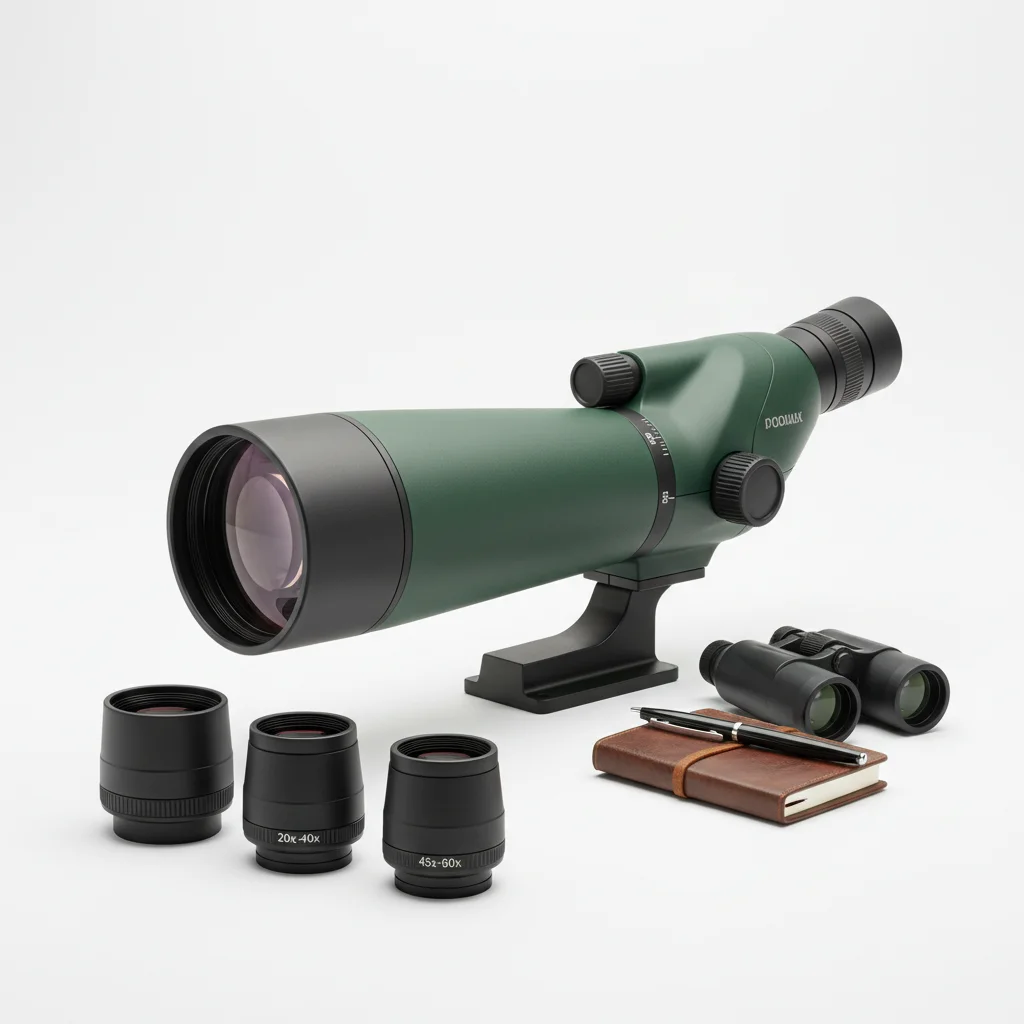
The ideal spotting scope magnification depends on its intended use, with 20-60x being sufficient for most outdoor activities like birdwatching, while specialized applications such as long-range target shooting or astronomy may require magnifications exceeding 80x. However, higher magnification often reduces the field of view and image brightness, necessitating a balance with objective lens size for optimal clarity.
Understanding Magnification Numbers
Spotting scopes are typically described by two numbers, such as 20-60×80. The first set of numbers (20-60x) indicates the variable magnification range, allowing adjustment from 20 times to 60 times closer than the naked eye. The second number (80) refers to the objective lens diameter in millimeters. While increased magnification brings distant objects closer, it also reduces the field of view and can dim images, particularly in low-light conditions. Balancing magnification with objective lens size is crucial for a bright, clear image.
Magnification for Birdwatching and Nature Observation
For birdwatching, wildlife observation, and general nature viewing, a magnification range between 20x and 45x is often optimal. This range offers a good balance of detail and a wide enough field of view to easily locate and track moving subjects. Higher magnifications can make it difficult to keep fast-moving birds in sight and can introduce more image shake, even with a sturdy tripod. Many enthusiasts find that a 20-60x scope is versatile, allowing them to reduce magnification for wider views and increase it for closer inspection when conditions permit.
- 20-30x: Excellent for a wide field of view and tracking moving subjects.
- 30-45x: Good for detailed observation of stationary wildlife.
- 45-60x: Useful for identifying subtle features at longer distances.
- Above 60x: Generally not recommended for handheld use; requires a very stable tripod.
Magnification for Target Shooting and Hunting
|
Our Picks for the Best Spotting Scope in 2026
As an Amazon Associate I earn from qualifying purchases.
|
||
| Num | Product | Action |
|---|---|---|
| 1 | 25-75X60 Spotting Scope with 51in Tripod, Spotting Scope for Target Shooting, Hunting & Bird Watching, Low Light Vision, Phone Adapter, Carry Bag, BAK4 Prism, FMC Lens, Waterproof (ArmyGreen) |

|
| 2 | SVBONY SV28 Spotting Scopes with Tripod, Angled 25-75x70mm Spotter Scope with Phone Adapter, Waterproof Fogproof Spotting Scope for Bird Watching, Target Shooting, Wildlife Viewing |
|
| 3 | Gosky Flagship 25-75x80 Spotting Scope - Spotting Scopes with Tripod, Carrying Bag and Quick Phone Holder BAK4 Waterproof Spotter Scope for Bird Watching Target Shooting,Upgraded Version |
|
| 4 | SVBONY SV28 100mm Angled Spotting Scope for Target Shooting, 25-75x Spotter Scope with Tripod for Long Range Viewing, FMC HD Optics with Soft Carrying Case & Phone Adapter, Scopes for Birdwatching |
|
| 5 | SVBONY SV28 20-60x80 New Version Spotting Scope for Target Shooting, Long Range Spotter Scope with Phone Adapter and Tripod, HD Scope for Bird Watching, Wildlife Observation |
|
| 6 | SVBONY SV28 Plus Spotting Scopes with Tripod, Angled Spotter Scope with Upgraded Phone Adapter, IP65 Waterproof Fogproof Long Range Spotting Scope for Target Shooting, Birding |
|
| 7 | High-Definition Spotting Scope for Bird Watching,Wildlife Viewing,Beginners Telescope,Target Observation.25-75×60mm HD Spotting Scope with Tripod and Phone Adapter,Monocular |
|
| 8 | Spotting Scope 20-60x60mm - Waterproof IPX7 Spotter Scope with Phone Adapter and Tripod, Portable for Bird Watching Wildlife observing and Hiking, Black |
|
| 9 | 25-75x70 HD Spotting Scope with BAK4 Prism FMC Lens, IPX7 Floating Fully Waterproof Spotting Scopes for Target Shooting Birding Wildlife Viewing Stargazing, Tripod Phone Adapter Carrying Bag(Green) |
|
| 10 | Gosky Flagship DiamondEdge 20-60x80 Spotting Scope with Tripod, Carrying Bag and Quick Phone Holder - BAK4 High Definition Waterproof Spotter Scope for Bird Watching Wildlife observing,Green |
|
For target shooting, especially at ranges of 300 yards and beyond, higher magnifications are often preferred. A 60x to 80x magnification can be very beneficial for spotting bullet holes on paper targets or observing impacts on steel. For hunting, requirements vary; some hunters prefer lower magnifications for a wider field of view and quicker target acquisition, while others opt for higher power to assess trophy quality from a distance. A common choice for both is a scope with a maximum magnification of 60x to 80x, providing flexibility for different scenarios.
Magnification for Astronomy
While dedicated astronomical telescopes are generally superior, many spotting scopes can be used for casual astronomy, particularly for observing the moon, planets, and brighter deep-sky objects. For astronomical viewing, higher magnifications, often in the 60x to 100x range, can reveal more detail. However, atmospheric conditions (seeing) play a significant role, and excessive magnification can lead to blurry or shimmering views. A large objective lens is also critical for gathering enough light to support these higher magnifications, ensuring a bright image of celestial bodies.
The Role of Objective Lens Diameter
The objective lens diameter, the second number in a scope’s specification (e.g., 80mm), is as important as magnification. A larger objective lens gathers more light, resulting in brighter and clearer images, especially at higher magnifications or in low-light conditions. For example, a 20-60x80mm scope will generally provide a brighter image than a 20-60x60mm scope at the same magnification. When considering higher magnifications, always pair them with a sufficiently large objective lens to avoid dim and unsatisfying views.
Frequently Asked Questions
What magnification is best for general outdoor activities like birdwatching?
For general outdoor activities such as birdwatching or casual nature observation, a magnification range of 20-60x is typically more than sufficient. This range provides a good balance of detail and a wide enough field of view to easily locate and track moving subjects.
How does objective lens diameter affect spotting scope performance?
The objective lens diameter, such as 80mm, is crucial because a larger lens gathers more light. This results in brighter and clearer images, especially at higher magnifications or in low-light conditions, improving overall viewing quality.
Is higher magnification always better for spotting scopes?
No, higher magnification is not always better. While it brings distant objects closer, it also reduces the field of view and can make images appear dimmer. It's essential to balance magnification with the objective lens size to ensure a bright, clear image and avoid blurry views.
What magnification is recommended for long-range target shooting?
For long-range target shooting, especially at 300 yards and beyond, higher magnifications are often preferred. A 60x to 80x magnification can be very beneficial for spotting bullet holes on paper targets or observing impacts on steel targets.
Can spotting scopes be used for astronomical viewing?
Yes, many spotting scopes can be used for casual astronomy, particularly for observing the moon, planets, and brighter deep-sky objects. For astronomical viewing, higher magnifications, often in the 60x to 100x range, can reveal more detail, though atmospheric conditions are a factor.

This really helped me understand the 20-60×80 numbers on my new scope. I was a bit confused about what the ’80’ meant, but now I get that it’s the objective lens diameter. It’s a solid scope for general outdoor use, and the variable magnification is super handy for different situations. Good to know I made a decent choice.
For astronomy, I needed something that could really push the limits, and a scope exceeding 80x magnification was exactly what I was looking for. The clarity is surprisingly good, even with the higher zoom, which I attribute to a good quality objective lens. It’s made a huge difference in my stargazing sessions.
I’ve been using a 20-60x scope for birdwatching for years, and it’s always been perfect for identifying species at a distance. The point about balancing magnification with objective lens size really resonated with me. My 60mm objective lens keeps things bright even when I’m zoomed all the way in. Great advice for anyone looking to upgrade or buy their first scope.
I recently got a scope with 80x magnification for long-range target shooting, and while it’s amazing for seeing bullet holes, the field of view is definitely smaller than I expected. It takes a bit more effort to track targets. I wish I’d paid more attention to that trade-off before buying, but it still gets the job done for precision work.