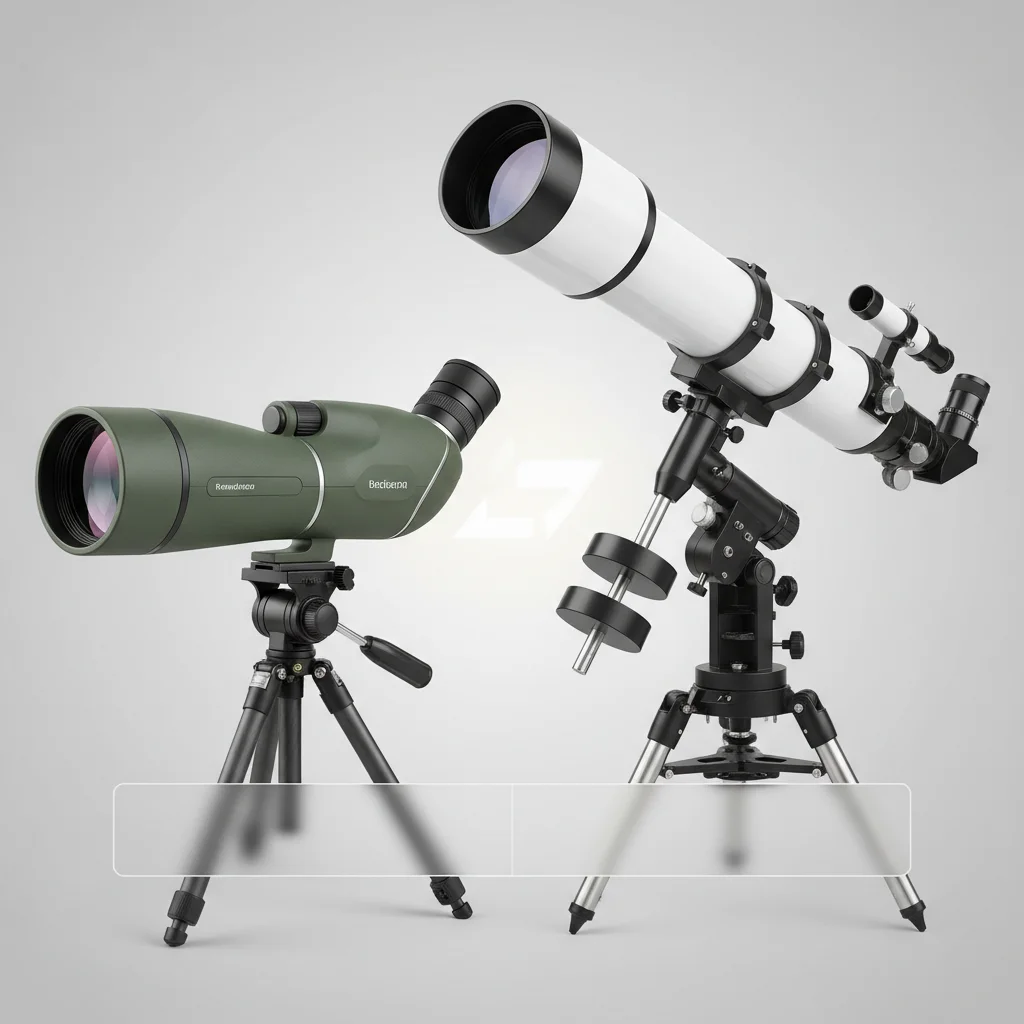
Choosing between a spotting scope and a telescope depends entirely on your primary viewing objectives. A spotting scope is generally more versatile for terrestrial observations due to its compact design and typically waterproof construction, offering magnifications up to 60x. In contrast, a telescope is optimized for astronomical viewing, providing significantly higher magnifications and light-gathering capabilities for distant celestial objects.
Understanding Spotting Scopes: Terrestrial Versatility
Spotting scopes are engineered for portability and ruggedness, making them ideal for outdoor activities such as birdwatching, hunting, target shooting, and even some casual stargazing. They typically feature a straight or angled eyepiece, allowing for comfortable viewing in various positions. Their optical design often prioritizes a wider field of view and closer focusing distances compared to most telescopes, which is crucial for tracking moving subjects or observing details in landscapes. Many models are also nitrogen-purged and O-ring sealed, providing fog-proof and waterproof performance in challenging weather conditions.
The magnification range of a spotting scope usually falls between 15x and 60x, with objective lens diameters ranging from 50mm to 100mm. This balance of magnification and light gathering is perfect for resolving fine details on distant terrestrial targets without the bulk of a large astronomical telescope. Their robust construction means they can withstand the bumps and scrapes of outdoor use, a key advantage for adventurers and field enthusiasts.
Exploring Telescopes: Astronomical Prowess
Telescopes are primarily designed for observing celestial objects, from the moon and planets to distant galaxies and nebulae. They excel at gathering light from faint sources and providing extremely high magnifications, often exceeding 100x, to reveal intricate astronomical details. There are several types of telescopes, including refractors, reflectors (Newtonian, Dobsonian), and catadioptrics (Schmidt-Cassegrain, Maksutov-Cassegrain), each with its own optical advantages and disadvantages.
Refractor telescopes, for instance, use lenses to gather and focus light, offering sharp, high-contrast images, while reflector telescopes use mirrors, allowing for larger apertures at a more affordable price point. The larger aperture of a telescope is critical for collecting enough light to view dim deep-sky objects, a task where most spotting scopes would struggle. While some telescopes can be adapted for terrestrial viewing, they often present an inverted or reversed image, requiring an additional erecting prism for correct orientation, which can add to the cost and complexity.
Key Differences in Design and Application
|
Our Picks for the Best Spotting Scope in 2026
As an Amazon Associate I earn from qualifying purchases.
|
||
| Num | Product | Action |
|---|---|---|
| 1 | 25-75X60 Spotting Scope with 51in Tripod, Spotting Scope for Target Shooting, Hunting & Bird Watching, Low Light Vision, Phone Adapter, Carry Bag, BAK4 Prism, FMC Lens, Waterproof (ArmyGreen) |

|
| 2 | 25-75x70 HD Spotting Scope with BAK4 Prism FMC Lens, IPX7 Floating Fully Waterproof Spotting Scopes for Target Shooting Birding Wildlife Viewing Stargazing, Tripod Phone Adapter Carrying Bag(Green) |
|
| 3 | Spotting Scope 20-60x60mm - Waterproof IPX7 Spotter Scope with Phone Adapter and Tripod, Portable for Bird Watching Wildlife observing and Hiking, Black |
|
| 4 | SVBONY SV28 100mm Angled Spotting Scope for Target Shooting, 25-75x Spotter Scope with Tripod for Long Range Viewing, FMC HD Optics with Soft Carrying Case & Phone Adapter, Scopes for Birdwatching |
|
| 5 | SVBONY SV28 20-60x80 New Version Spotting Scope for Target Shooting, Long Range Spotter Scope with Phone Adapter and Tripod, HD Scope for Bird Watching, Wildlife Observation |
|
| 6 | Gosky Flagship 25-75x80 Spotting Scope - Spotting Scopes with Tripod, Carrying Bag and Quick Phone Holder BAK4 Waterproof Spotter Scope for Bird Watching Target Shooting,Upgraded Version |
|
| 7 | SVBONY SV28 Plus Spotting Scopes with Tripod, Angled Spotter Scope with Upgraded Phone Adapter, IP65 Waterproof Fogproof Long Range Spotting Scope for Target Shooting, Birding |
|
| 8 | High-Definition Spotting Scope for Bird Watching,Wildlife Viewing,Beginners Telescope,Target Observation.25-75×60mm HD Spotting Scope with Tripod and Phone Adapter,Monocular |
|
| 9 | Gosky Flagship DiamondEdge 20-60x80 Spotting Scope with Tripod, Carrying Bag and Quick Phone Holder - BAK4 High Definition Waterproof Spotter Scope for Bird Watching Wildlife observing,Green |
|
| 10 | SVBONY SV28 Spotting Scopes with Tripod, Angled 25-75x70mm Spotter Scope with Phone Adapter, Waterproof Fogproof Spotting Scope for Bird Watching, Target Shooting, Wildlife Viewing |
|
The fundamental difference lies in their intended application. Spotting scopes are built for the rigors of the field, offering a durable, often waterproof design with moderate magnification and a wide field of view suitable for terrestrial observations. Telescopes, on the other hand, are optimized for stability and high magnification, designed to capture the faint light and intricate details of astronomical objects. Their larger apertures and longer focal lengths are less practical for quick, mobile terrestrial use.
Consider the eyepiece design as well. Spotting scopes often come with zoom eyepieces for quick magnification changes, and their eyepieces are typically designed for comfortable, upright viewing. Telescopes often use interchangeable fixed-magnification eyepieces, allowing for greater flexibility in achieving specific magnifications, but requiring more frequent swapping.
Portability and Setup Considerations
Portability is a significant factor when comparing these two optical instruments. Spotting scopes are generally more compact and lighter, making them easy to transport and set up quickly in the field. They typically mount on standard photographic tripods, which are also relatively lightweight. Telescopes, especially those with larger apertures, can be quite bulky and heavy, often requiring specialized, robust mounts (like equatorial or alt-azimuth mounts) for stable viewing at high magnifications. Setting up a telescope for optimal astronomical observation can also be more time-consuming, involving alignment and calibration.
Cost and Accessory Ecosystems
The cost of spotting scopes and telescopes can vary widely, depending on the brand, optical quality, and features. Generally, entry-level spotting scopes are more affordable than comparable entry-level astronomical telescopes with similar aperture sizes, especially when considering the necessary accessories. Both instruments have extensive accessory ecosystems, but they cater to different needs. Spotting scope accessories often include digiscoping adapters for photography, protective cases, and specialized tripods. Telescope accessories, however, focus on enhancing astronomical viewing, such as various eyepieces, Barlow lenses, filters, and tracking motors.
- Spotting scopes are ideal for terrestrial viewing and portability.
- Telescopes excel at astronomical observations and high magnification.
- Spotting scopes are typically waterproof and rugged.
- Telescopes often require more stable and specialized mounts.
- Magnification ranges and light-gathering capabilities differ significantly.
Frequently Asked Questions
What is the main difference between a spotting scope and a telescope?
The main difference is their primary application: spotting scopes are designed for terrestrial viewing and portability, offering magnifications up to 60x, while telescopes are optimized for astronomical observations with significantly higher magnifications for celestial objects.
Are spotting scopes suitable for stargazing?
Spotting scopes can be used for casual stargazing, especially for observing the moon and brighter planets. However, they are not as powerful as dedicated astronomical telescopes for viewing faint deep-sky objects due to their lower light-gathering capabilities and magnification range, typically 15x to 60x.
Which optical tool is better for birdwatching and hunting?
Spotting scopes are better for birdwatching and hunting. Their rugged, often waterproof design, portability, and moderate magnification (15x-60x) with a wide field of view make them ideal for tracking moving subjects and observing details in landscapes.
Do telescopes require special mounts for viewing?
Yes, telescopes, especially those with larger apertures, often require specialized, robust mounts like equatorial or alt-azimuth mounts for stable viewing at high magnifications. Spotting scopes typically mount on standard photographic tripods.
Can a telescope be used for terrestrial viewing?
While some telescopes can be adapted for terrestrial viewing, they often present an inverted or reversed image. An additional erecting prism is usually required for correct orientation, which adds to the cost and complexity, making them less practical than a spotting scope for this purpose.

I’ve been using a spotting scope for birdwatching for years, and the versatility for terrestrial observations is exactly why I love it. The compact design makes it easy to carry on hikes, and I’ve even used it for some casual stargazing when I forget my main telescope. Definitely recommend for anyone who spends a lot of time outdoors.
I got a spotting scope hoping it would be a good all-around option, but I’m a bit disappointed with its performance for astronomical viewing. While it’s fine for bright objects, it just doesn’t have the light-gathering capabilities of a dedicated telescope. It’s great for hunting, but don’t expect too much from it for serious stargazing.
This spotting scope has been a game-changer for my hunting trips. The ruggedness and portability are exactly what I needed. I opted for one with an angled eyepiece, and it makes viewing so much more comfortable, especially when I’m set up for long periods. Highly recommend for any serious hunter.
I was torn between a spotting scope and a telescope for target shooting, and I’m glad I went with the scope. The magnifications up to 60x are perfect for seeing my shots at a distance. It’s also waterproof, which is a huge plus when I’m out in the field. Great for its intended purpose.